What is an Asset View?
An Asset View provides a consolidated and categorized summary of a user's financial holdings across multiple accounts and financial institutions, as retrieved through the Account Aggregator (AA) framework.
It is designed to give Financial Information Users (FIUs) or end-users a structured and easy-to-understand snapshot of their overall financial health.
The Asset View is a user-friendly representation layer built on top of the raw, structured financial data fetched via the Account Aggregator framework. It ensures clarity, compliance, and consistency in how financial data is interpreted and presented.
Purpose of Asset View
- Summarization: Combines data from various Financial Information Providers (FIPs) into meaningful categories such as deposits, investments, insurance, loans, and pensions.
- Visualization: Helps users visualize their net worth and financial position through categorized breakdowns (e.g., total balance in savings accounts, total equity holdings, etc.).
- Decision Support: Enables better financial decisions by presenting clean, deduplicated, and verified information directly fetched via consent.
Common Categories in Asset View
- Deposits: Total balances from savings, current, and fixed deposit accounts.
- Mutual Funds: Current valuation, fund types, and asset mix.
- Equities: Individual stock holdings and market value.
Data Source
The information shown in the Asset View is pulled from the FIU’s backend after:
- User Consent is granted.
- FI Data is fetched via the AA network.
- Data is Parsed and mapped into standard categories using schema definitions from ReBIT.
Asset View Overview
This section provides a visual representation of the various asset views available in the platform. It showcases deposits, stock holdings, mutual fund holdings, their transactions, and graphical insights.
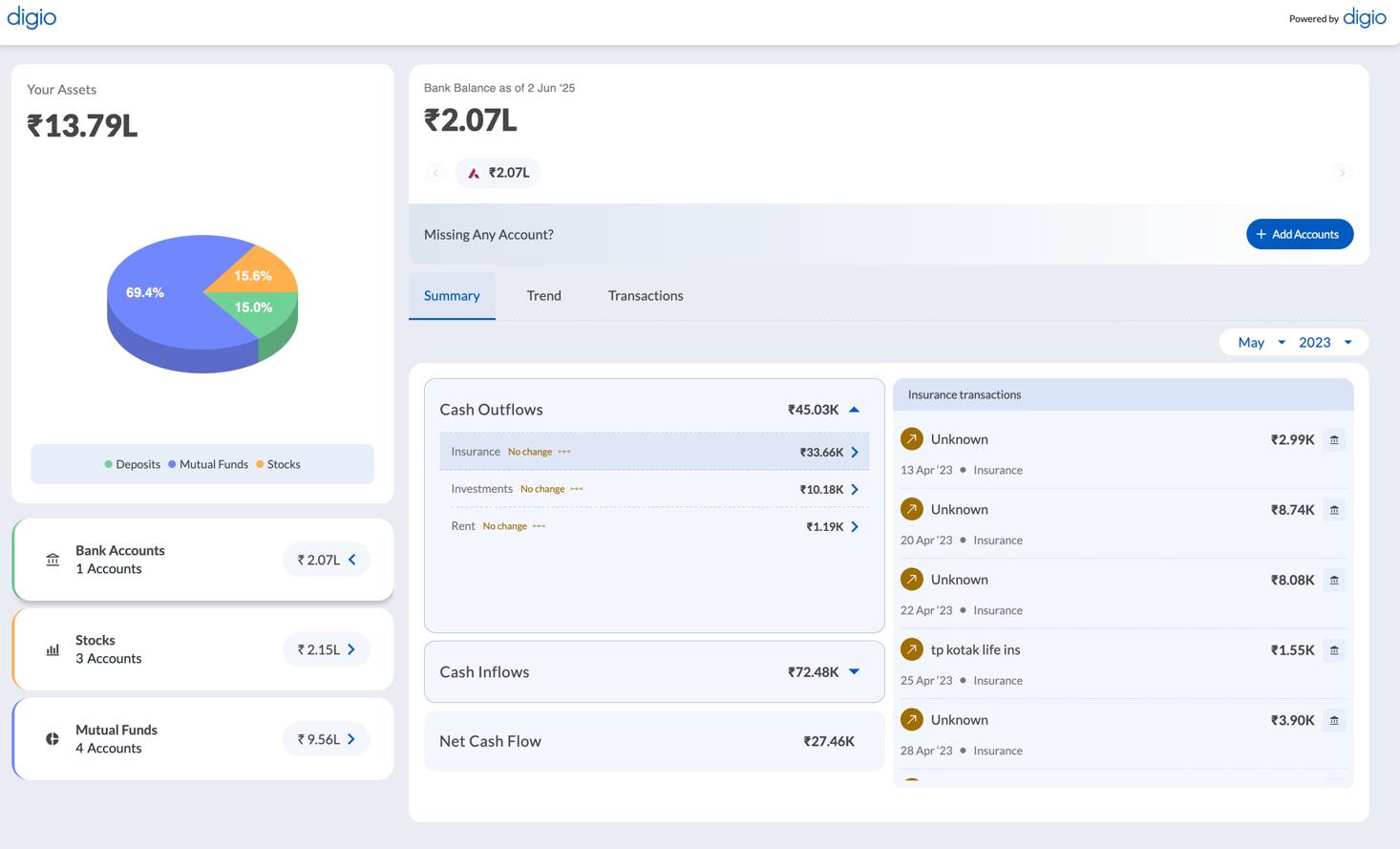
1. Deposit Overview
This section highlights the cash inflows and outflows of a customer, providing a clear picture of liquidity and spending behavior. The data shown includes individual transactions, customer metadata, and categorized cash movement.
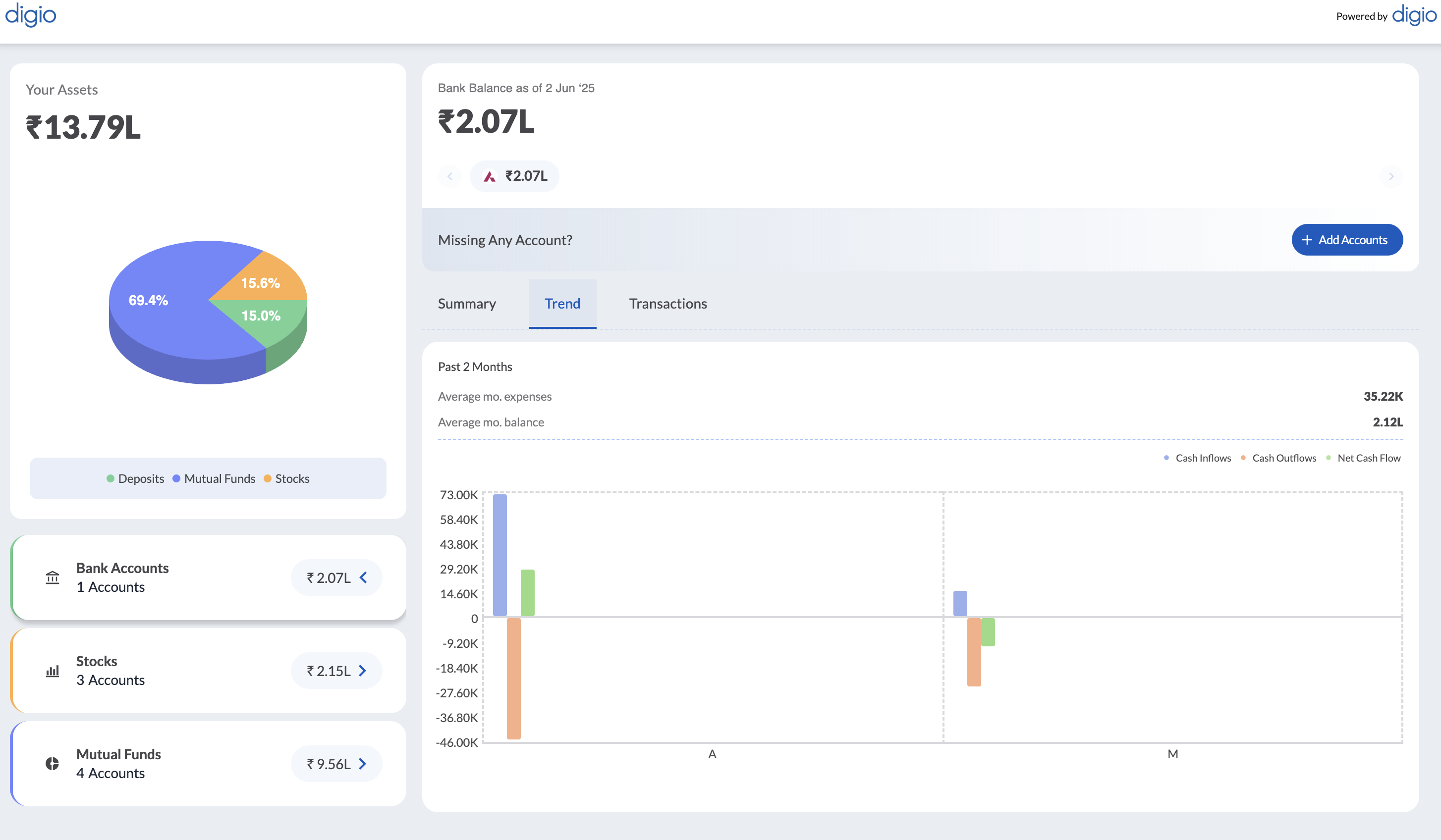
2. Deposit Analytics Charts
These charts display average monthly expenses and average monthly balances over a specific time range. This helps users assess financial trends and budget patterns visually.
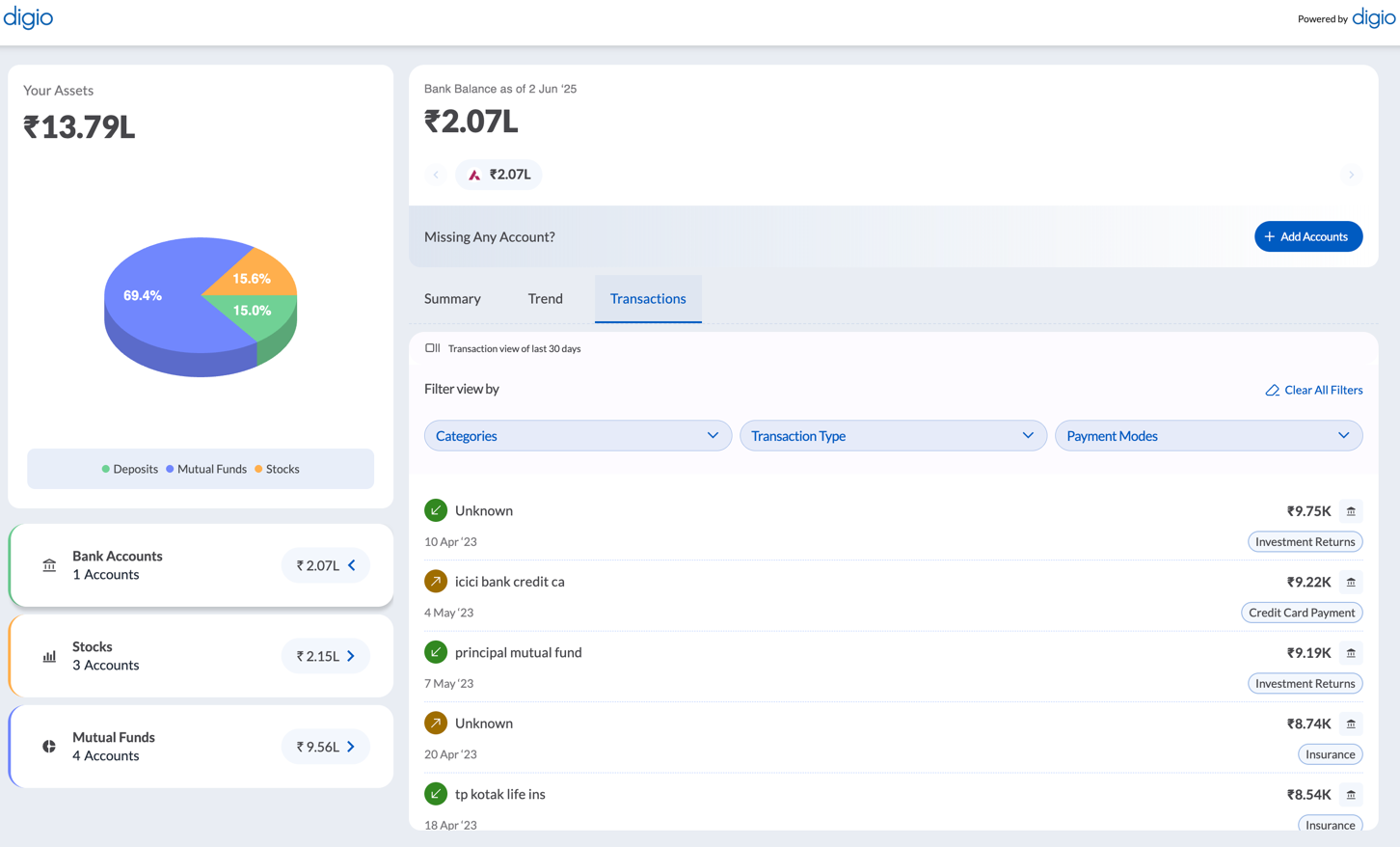
3. Deposit Transactions with Filters
This view lists individual deposit transactions in detail, along with interactive filters that allow users to refine data by:
- Transaction Category (e.g., salary, utility, rent)
- Transaction Type (credit or debit)
- Payment Mode (UPI, Netbanking, Cheque, etc.)
Such granular filtering makes it easier to navigate and analyze specific subsets of financial activity.
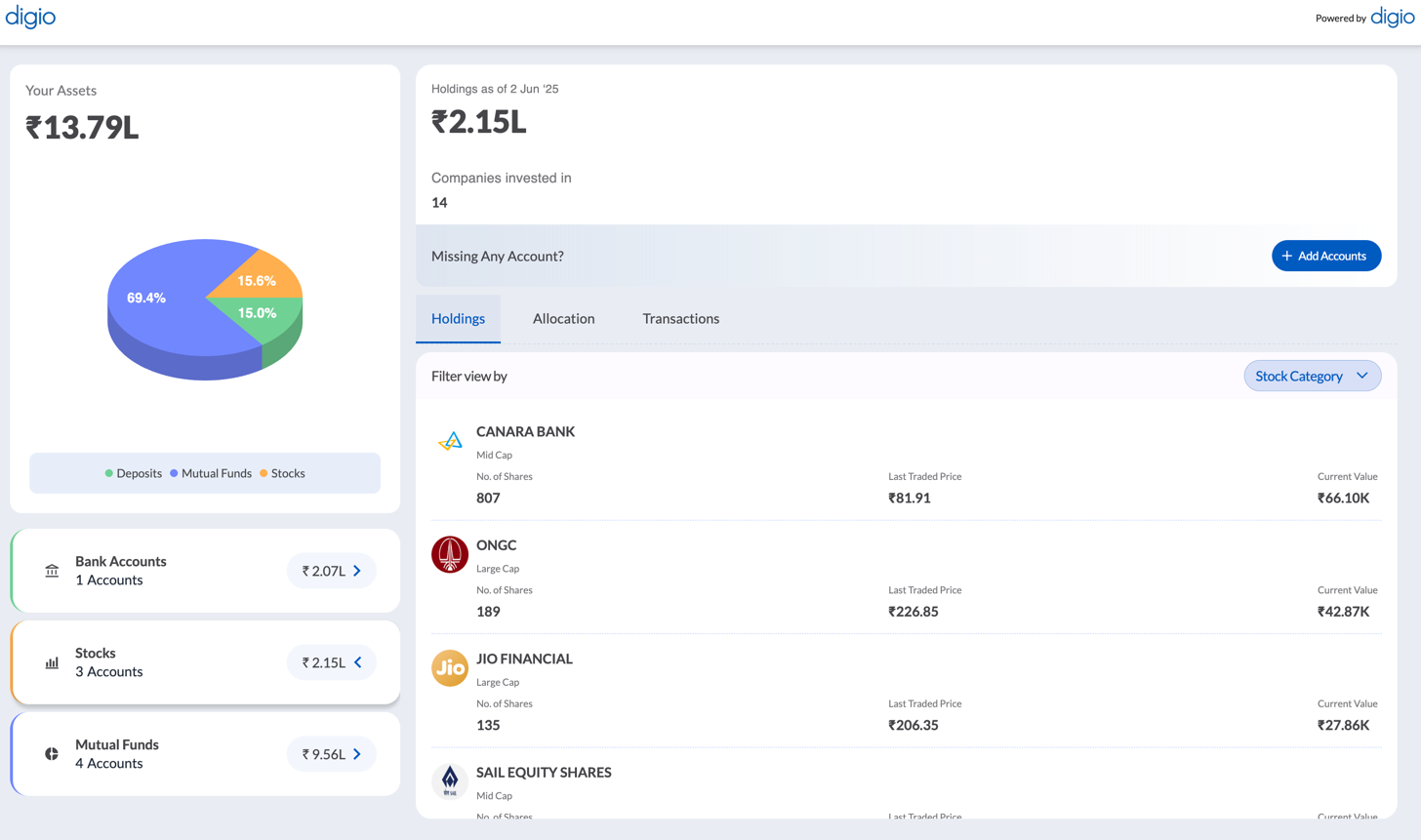
4. Stock Holding Overview
This section presents the user's equity stock holdings, including company names, quantity held, and the total value of each investment. It gives a snapshot of the user's exposure to stock market instruments.
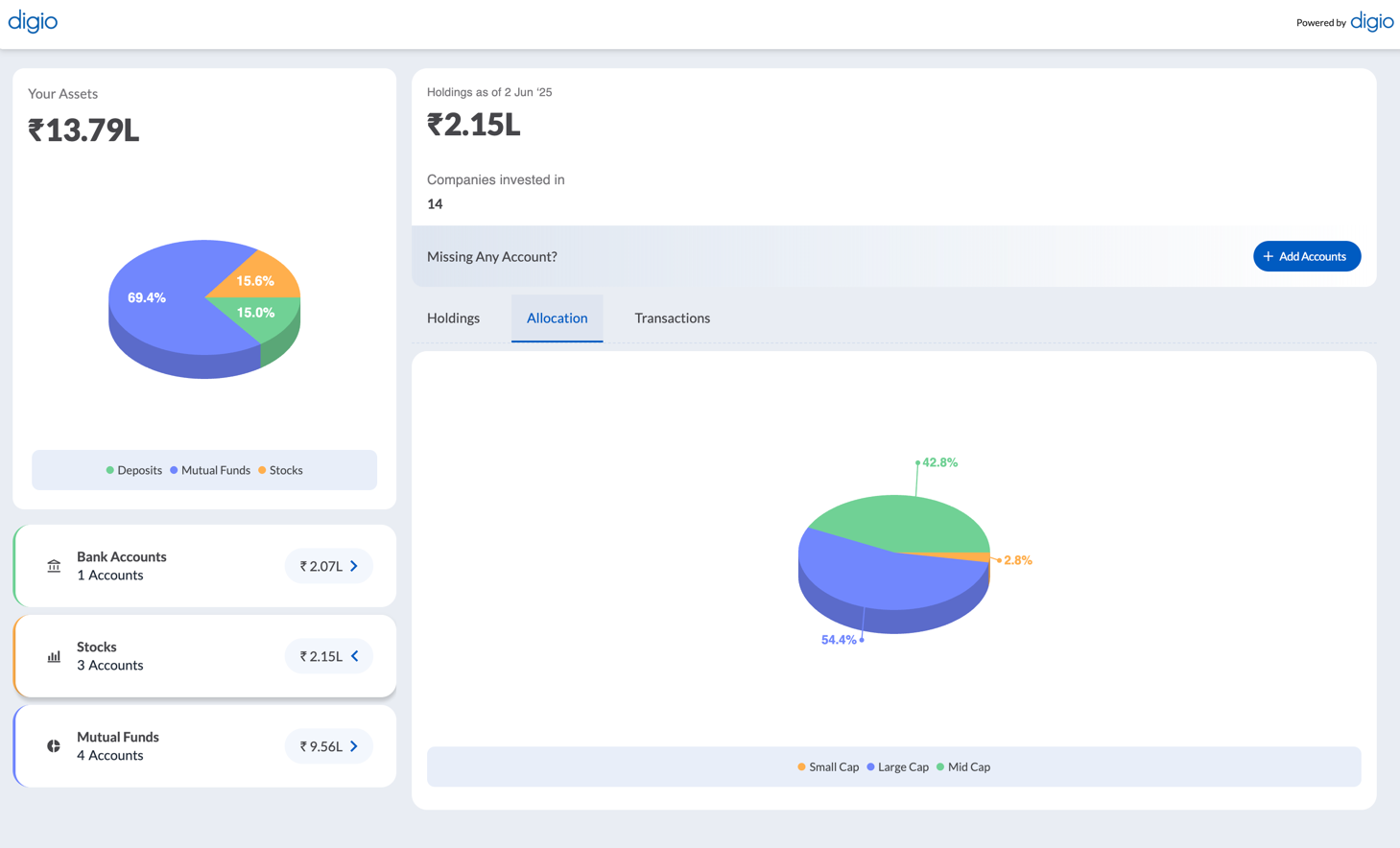
5. Stock Allocation Breakdown
Here, stock investments are categorized based on market capitalization:
- Large Cap
- Mid Cap
- Small Cap
This allocation helps assess the risk level and diversification of the portfolio.
6. Stock Transaction History
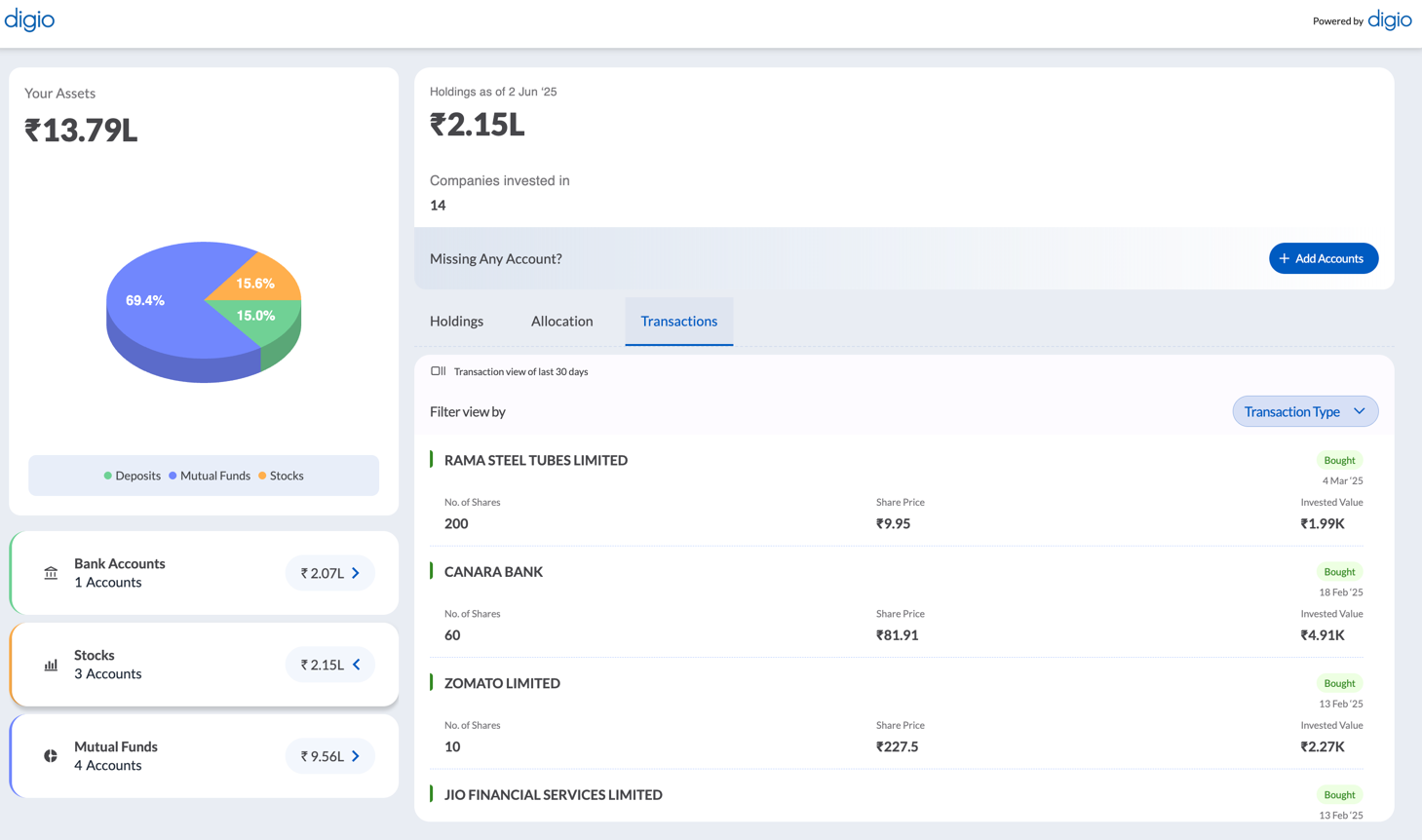
A detailed breakdown of buy/sell transactions related to stocks. It includes trade dates, prices, units traded, and other important trade-related metadata.
7. Mutual Fund Holdings
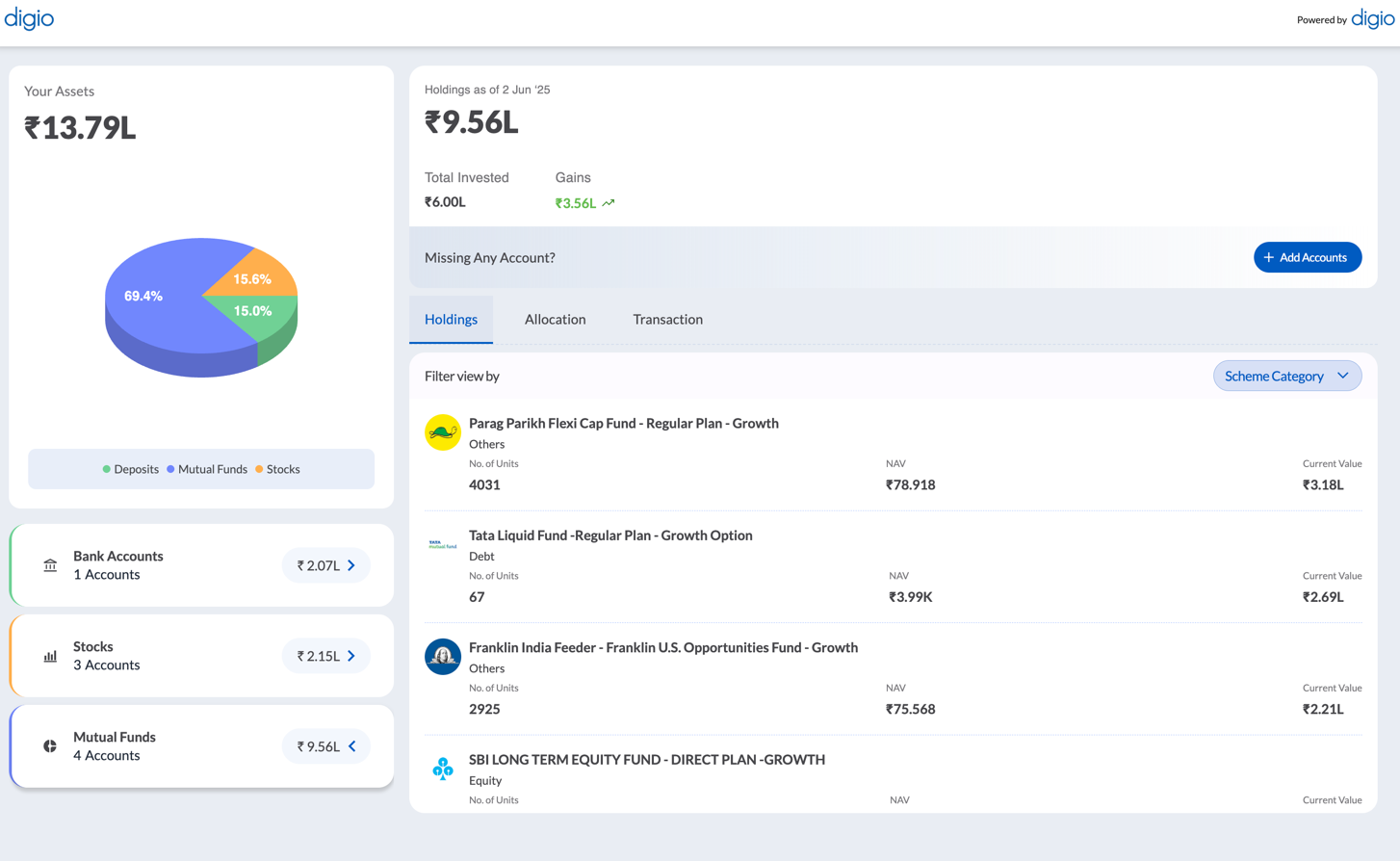
This view shows the user's mutual fund investments, listing fund names, NAVs, units held, and current market value. It gives clarity on where and how much the user has invested.
8. Mutual Fund Allocation
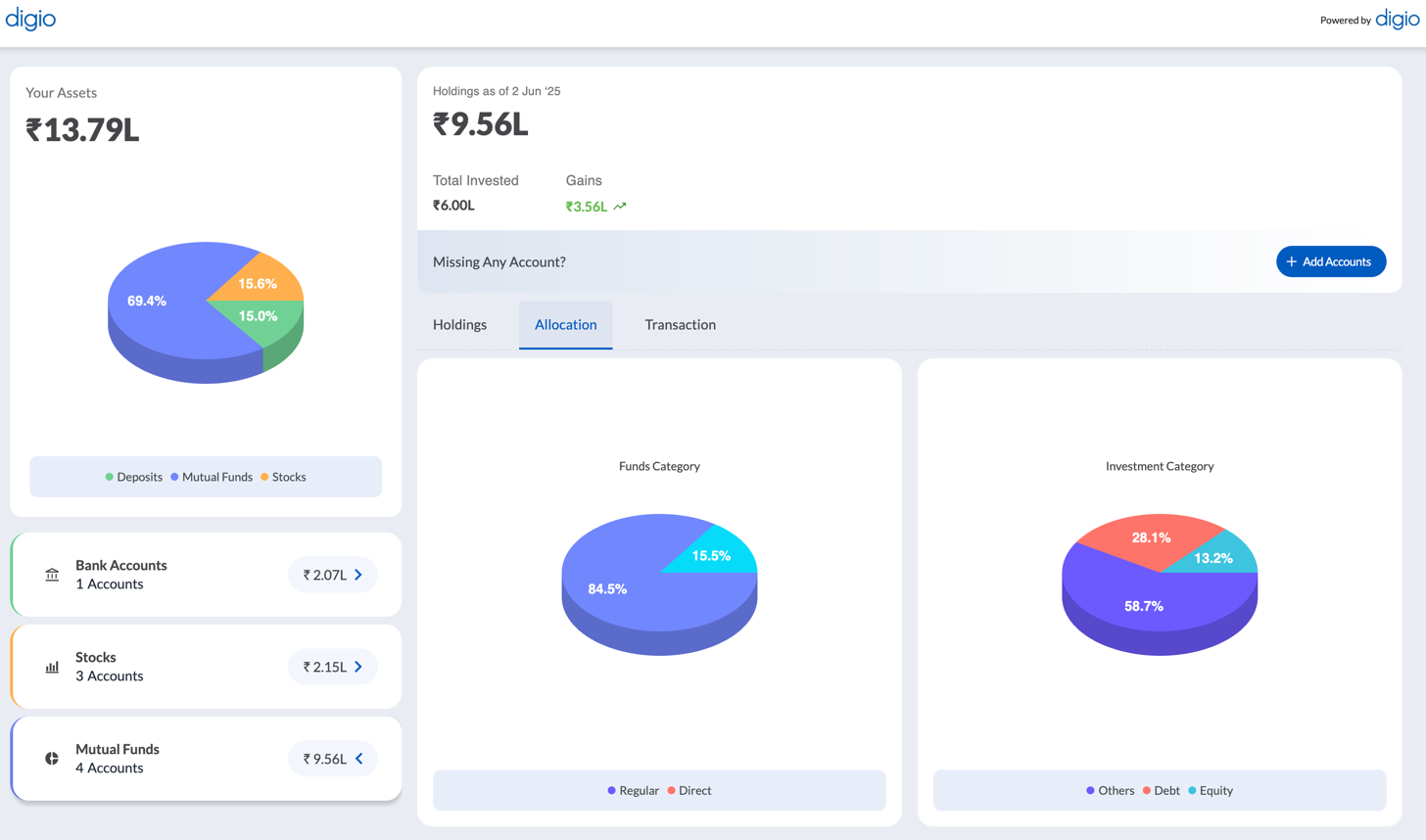
Mutual fund investments are categorized by:
- Fund Category: Regular vs. Direct
- Investment Type: Debt, Equity, or Hybrid (Others)
This categorization aids in understanding the investment strategy and fund exposure.
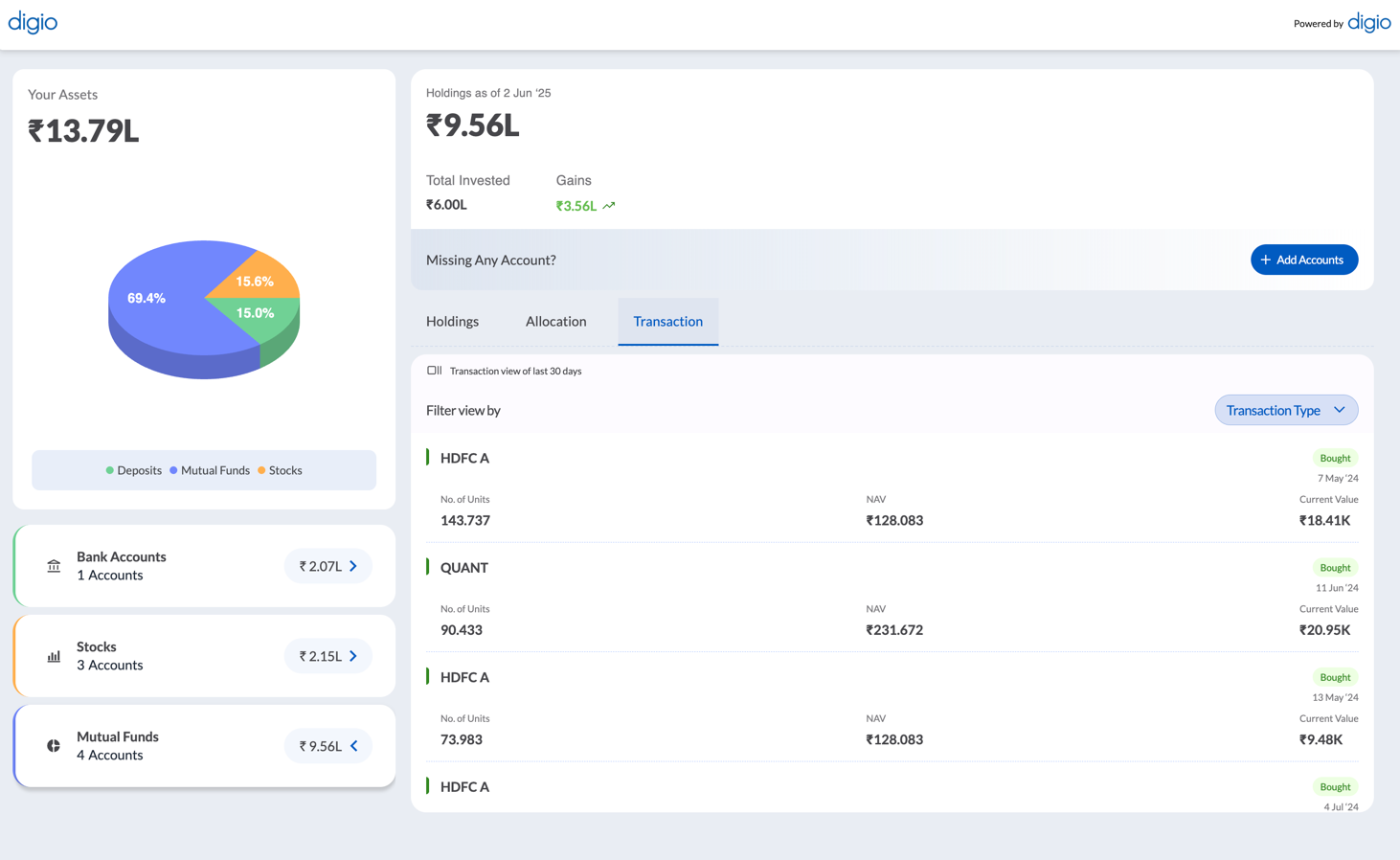
9. Mutual Fund Transaction History
This section displays transaction records for all mutual fund investments, such as SIPs, lump-sum purchases, redemptions, and switches. It is useful for auditing and monitoring investment behavior.
Use Cases
- Personal finance management dashboards
- Wealth advisory and investment tracking
- Automated income or net worth verification